

 You’ll use your ladder many times throughout the year, but this is a good time to remind you of ladder safety and injury prevention.
One summer Sunday, Dr. Tim Degelman, a Prince Albert optometrist, was about to do something he has done many times before. , His youngest son Dane’s 7th birthday party was the next day, so Tim was getting the bouncy castle from the loft in the garage. He grabbed the extension ladder – but this time didn’t end like the other times.
He was standing on a high rung of the ladder, leveraging with his legs to pull the box towards him. What happened next came fast. As the ladder slid out from under him on the wet garage floor and he fell 14 feet, all he recalls thinking was, “Don’t let your head hit the concrete.”
Tim’s left foot caught in the ladder and his left wrist and lower back absorbed the brunt of the impact. His two children, who were helping with yard work, started to cry. The 12-year-old, Brock, quickly phoned 911. “In a state of shock, I told my son to cancel the ambulance. I thought I just needed to get to the couch and take a couple of Advil.” He tried to crawl to the doorway but realized he was in serious trouble. “My son called my wife who called 911 again for the ambulance.”
X-rays and a CT-scan determined that Tim broke his foot in multiple places. He needed surgery on his left wrist. The repair included with four screws, a plate and two pins. A bone in his spine broke off and he had bruising and damage around his tailbone. After four days in the hospital on a morphine drip, it was time to return home.
Preparation for life back home was intense. Tim spent time with doctors, nurses and physiotherapists. Occupational therapy set up pain control, crutches, walkers, bathroom aids, ramps to the house and a scooter to get around. “My wife has been amazing at taking care of me, but it certainly has caused some stress for the entire family,” says Tim. “I had to take 6 weeks off work. I spent a lot of time immobile and I was frustrated.”
Missing summer fun with his family, dealing with pain, casts and other inconveniences was difficult for Tim and for his wife and children.
Time will heal most of Tim’s injuries, but he will likely have life-long issues of arthritis and reduced mobility in his foot and wrist. “I am fortunate to be alive. A more significant spinal or head injury could have been so much worse,” adds Tim.
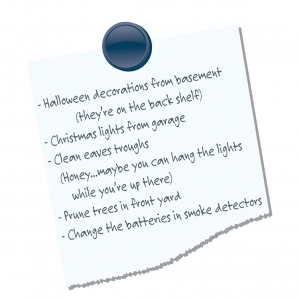
“This injury was preventable,” he realizes. “I share my story so that others may not have to go through the pain and aggravation I went through. Slow down. Think safety first. Have someone hold the ladder for you. Or better yet, hire the experts for tasks like Christmas lights, eaves trough cleaning and tree removal. Life is too precious.”
One bad step is all it takes
The Saskatchewan Construction Safety Association provides ladder safety tips:
When you are setting up a ladder:
- Make sure manufactured portable ladders comply with CSA and ANSI standards.
- Make sure the ladder is placed on even ground and within reach of your work.
- Use anti-skid adjustable feet, secure blocking or have someone hold the ladder.
- Don’t use any ladder (even wood) near electrical circuits or power lines.
- Extend the ladder 1 m (4 feet) above a landing if you are using it for access.
- Rest both side rails on the top support and secure it against movement.
- Don’t stand a ladder on ice or snow.
- Don’t use an unstable object like a rock or a brick to level the ladder’s feet.
- If you are setting up in front of a closed door, open the door or lock it.
- Do not use the two top rungs of the ladder.
- Don’t stand a ladder on another object. Get a ladder that’s the right height for the job.
- Make sure your ladder is at a safe angle, stabilized and secure.
- Always climb and descend facing the ladder, holding on to the rungs or steps as you climb (not the side rails).
- Always use three points of contact when you are climbing or going down a ladder.
- Climb one step at a time and don’t climb or descend with tools or buckets in your hands.
- To maintain your balance, keep the middle of your body between the ladder’s side rails. Don’t stretch or overextend yourself.
The key to ladder safety is selecting the right ladder for the job. Clean footwear, use of both hands while climbing and proper setup will reduce the chances of injury. Secure the ladder at top and bottom and make sure it is at an appropriate angle.

